Struggles to strategies for STEM women
Welcome to The Resistance Room's guide on navigating and overcoming challenges in STEM. Here, you'll find actionable insights, supportive resources, and the data you need to feel empowered and confident in your career journey.

Addressing the challenges in STEM
Women in STEM too often face significant hurdles, from sexual violence and harassment to unfair pay, unequal treatment, and even harder grading in academic settings. These issues can undermine confidence and deter women from pursuing their passions. The Resistance Room is dedicated to equipping you with the knowledge and tools to confront these problems head-on.

Empowerment through knowledge and community
After engaging with the advice and resources here, our goal is for you to feel empowered and strong sense of belonging within the STEM community. You will gain the confidence to pursue and excel in your chosen career, and recognize that you are not alone in your experiences. We believe that by providing statistics and their sources, we can collectively challenge the narrative that STEM is a male-only domain. Together, we can create a more equal and supportive future.
Share your own experiences and connect with others in Stories from STEM Women.
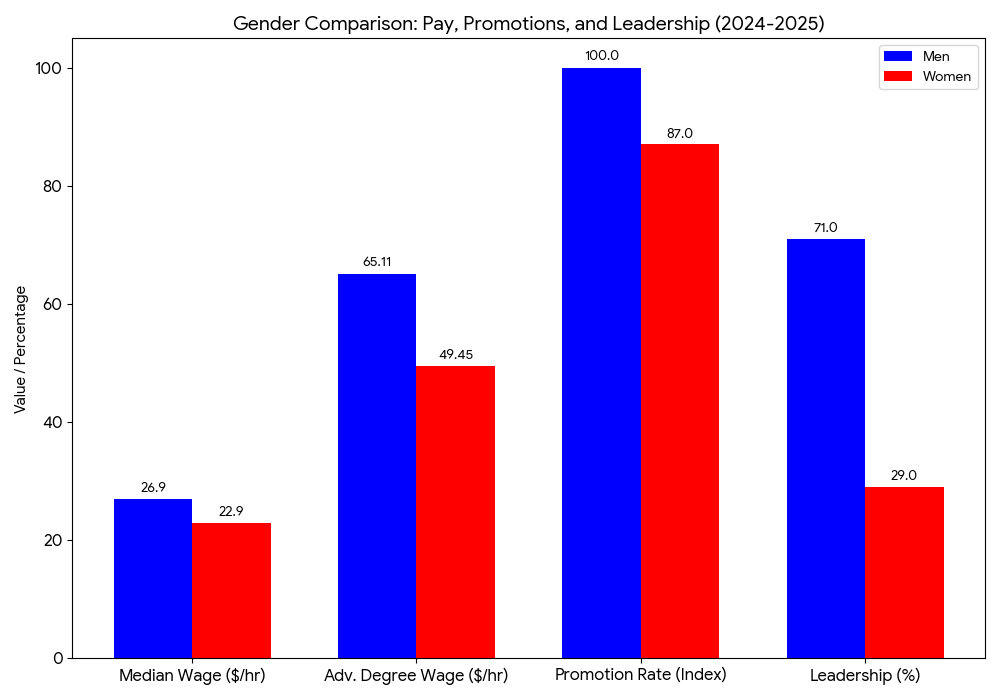
This bar chart illustrates the persistent disparities between men and women across key economic and professional metrics in 2024 and 2025.
Sources:

Less than half of women formally report workplace harassment, highlighting barriers such as fear of retaliation or lack of support.
Source: U.S. Equal Employment Opportunity Commission (EEOC), Women in STEM Special Topics Report (FY 2020)

Survey findings revealed that women most commonly reported unequal treatment in three key areas: generalized harassment, sexual harassment, and pregnancy-related harassment.
Source: U.S. Equal Employment Opportunity Commission (EEOC), Women in STEM Special Topics Report (FY 2020)
Beyond the ordinary
Gender Comparison: Pay, Promotions, and Leadership
The data compares four critical areas:
-
Median Hourly Wage: In the general workforce, men earn a median hourly wage of $26.90, while women earn $22.90.
-
Advanced Degree Wage: Education does not eliminate the gap; women with advanced degrees earn an average of $49.45 per hour, which is significantly less than the $65.11 earned by their male counterparts.
-
Promotion Rate: Within the tech sector, for every 100 men promoted from entry-level to manager, only 87 women achieve the same advancement, highlighting the "broken rung" in the corporate ladder.
-
Leadership Representation: Women remain severely underrepresented at the highest levels of corporate power, holding only 29% of C-suite positions in technology companies.
Description of the Gender Gap
Despite the gender pay gap hitting a historic low in 2024, significant structural barriers remain. Women are paid less than men at every education level and across all parts of the wage distribution. In the technology sector specifically, these disparities are compounded by a lack of representation in leadership and a slower rate of promotion. While women earn 84 cents for every dollar men earn in tech, the gap is even wider for women of color. Furthermore, nearly 50% of women leave the tech industry by age 35, often citing workplace culture and a lack of advancement opportunities as primary factors.

What Can You Do To Change These Statistics?
1. Grassroots Organizations & Feminist Groups
-
Girls Who Code: This organization focuses on closing the gender gap in technology by providing young women with the computing skills and confidence needed to pursue 21st-century opportunities.
-
Black Girls CODE: Dedicated to providing African-American youth with the skills to occupy some of the 1.4 million computing job openings expected in the U.S., focusing on underrepresented communities.
-
National Organization for Women (NOW): As the largest organization of feminist grassroots activists in the U.S., NOW leads campaigns for constitutional equality, economic justice, and ending violence against women.
2. Campaigns for Pay Equity & Professional Growth
-
Equal Pay Today: A project of Equal Rights Advocates, this campaign focuses on closing the gender wage gap by addressing occupational segregation, pregnancy discrimination, and wage theft.
-
The 30% Club: A global campaign led by Chairs and CEOs taking action to increase gender diversity at board and executive committee levels.
-
Lean In: Founded by Sheryl Sandberg, this global community offers "Circles" (small peer support groups) and research-backed programs to help women achieve their ambitions.
3. Protests & Policy Advocacy
-
The Women's March: While known for large-scale mobilizations, they maintain ongoing "Global Power Modules" that focus on economic justice and labor rights for women.
-
A Day Without a Woman: An international strike campaign that highlights the economic power and significance of women in the labor force while protesting wage inequality and labor misbehavior.
How to Take Action Now
-
Support Policy Advocacy: Organizations like the Economic Policy Institute advocate for raising the federal minimum wage and strengthening collective bargaining rights, which disproportionately benefits women.
-
Use Transparency Tools: Use platforms like WomenHack to find companies that are transparent about their diversity statistics and committed to inclusive hiring.
-
Legal Support: If you or someone you know is facing workplace discrimination, Equal Rights Advocates provides legal counseling and advocacy for women's economic rights.
Visit teh resource library for more!


Create Your Own Website With Webador